
Drugstore vs. Department Store Beauty Products: Where the Differences Are Real

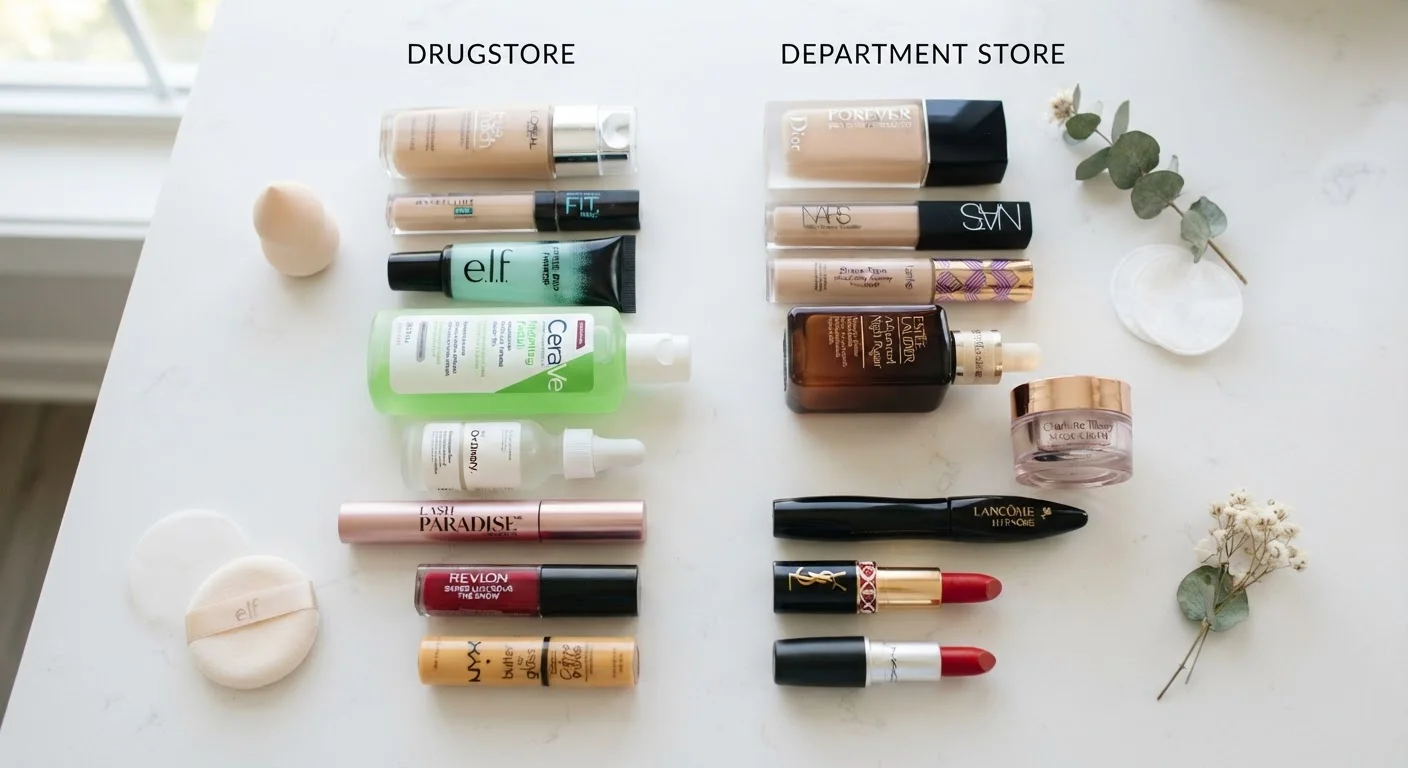
Photo: ConfiReads.com | Blogs For Inquisitive Minds editorial
Key Takeaways
- Drugstore mascaras, eyeliners, and lip products frequently rival high-end counterparts in performance.
- Skincare active ingredients matter more than brand tier - check concentrations, not price points.
- Foundation shade range and wear time are areas where department store formulas sometimes hold a real edge.
- Packaging and fragrance often account for a significant portion of luxury beauty pricing.
- A strategic mix of drugstore and department store picks is how most beauty editors actually shop.
The Price Gap - What's Actually Behind It
Walk down any beauty aisle and the price spread is staggering: a drugstore serum for $12, its department store counterpart for $120. So what are you actually paying for? The answer is nuanced, and it's almost never purely about formula quality.
Luxury beauty pricing reflects a bundle of factors: research and development investment, premium raw material sourcing, elaborate packaging, brand positioning, retailer margin, and - significantly - fragrance and sensory experience. A beautifully weighted glass bottle with a silk-finish label costs real money to produce, and that cost passes to you.
That doesn't mean high price equals high performance. To understand what's really in a beauty formula, look at the ingredient list rather than the price sticker. U.S. cosmetic labels list ingredients in descending order of concentration - so a $15 vitamin C serum with ascorbic acid listed second may outperform a $90 version where it appears eighth.
Skincare: Where the Gap Is Most Real - and Most Overstated
Skincare is the category with the most legitimate variation between tiers - and also the most marketing noise. Here's how to think through it.
Where department store can genuinely win: Prescription-strength-adjacent actives (retinoids at higher concentrations, stabilized vitamin C, encapsulated peptides) sometimes appear in higher-end lines at meaningfully effective concentrations. Formulation stability - keeping an active ingredient shelf-stable and bioavailable - is real science that costs money to execute well.
Where drugstore holds its own: Basic moisturizers, SPF products, gentle cleansers, and ceramide-based barrier creams are areas where drugstore brands have invested heavily. Dermatologists frequently recommend straightforward drugstore moisturizers precisely because simplicity reduces irritation risk. If you want to go deeper on how actives like AHAs and BHAs actually behave on skin, see our piece on chemical exfoliants vs. physical scrubs.
One consistent caution: fragrance is a leading driver of contact dermatitis, and luxury products are not necessarily fragrance-free. Learn more about the trade-offs in fragrance in skincare.
Compare Ingredient Lists, Not Prices
Makeup: Category by Category
| Category | Drugstore Performance | Department Store Performance | |
|---|---|---|---|
| Mascara | Frequently matches or beats high-end | Strong, but gap is minimal | |
| Eyeliner | Highly competitive, long-wear options abound | Minor edge in precision applicators | |
| Lip Color | Excellent pigment payoff, wide shade range | Richer texture and longevity in some formulas | |
| Foundation | Improving, but shade range can be limited | Often broader range, better undertone matching | |
| Skincare Actives | Solid basics; concentrations vary widely | Higher chance of effective active concentrations | |
| SPF / Moisturizer | Strong value; dermatologist-recommended picks | Marginal formula advantage; often overpriced | |
| Setting Powder | Very strong; performance differences minimal | Packaging and texture refinement, not results |
The comparison above tells a clear story: drugstore tends to punch hardest in eye and lip categories, while department store earns its price in foundation breadth and long-wear technology. If you're building a makeup collection from scratch, a hybrid approach stretches your budget smartly.
Foundation deserves special mention. Shade range, undertone accuracy, and oxidation (how a shade shifts after application) are areas where higher-investment brands have historically done more work - though mass-market brands have closed this gap considerably. For a deeper look at base product types, see tinted moisturizer vs. foundation vs. BB cream, and for tips on finding the right shade for your complexion, inclusive beauty fundamentals is a solid resource.
The Label Trap: 'Clean,' 'Natural,' and 'Luxury' Are Marketing, Not Standards
Department store shelves are stacked with products labeled 'clean,' 'non-toxic,' and 'natural' - often at significant price premiums. What's worth knowing: in U.S. cosmetics, none of those terms carry a legal definition or regulatory requirement. A $95 'clean' serum is not held to a different safety standard than a $14 drugstore alternative under current FDA rules.
That doesn't mean clean-beauty positioning is meaningless - some brands voluntarily exclude ingredients associated with sensitization. But it does mean the price premium is not a proxy for safety. Our guide to clean beauty claims and what labels actually mean legally walks through exactly what those terms can and cannot tell you.
Also worth noting: the application order you use matters as much as the products themselves. Whether you're using a $12 primer or a $60 one, sequence affects wear. See the makeup order most people get wrong for the logic behind layering.
Don't Equate Price With Safety or Efficacy
How to Shop Both Tiers Strategically
The beauty editors' open secret: almost no one shops exclusively at one tier. The practical playbook is straightforward - invest where complexity and concentration genuinely matter, and save confidently where the formulas are functionally equivalent.
- Splurge: Targeted skincare actives (retinoids, stable vitamin C serums), foundation if shade range is a persistent challenge for your complexion, long-wear setting products for special occasions.
- Save: Mascara, eyeliner, lip color, setting powder, micellar water, SPF moisturizers, basic cleansers.
- Always check: The ingredient list - not the aesthetic - before buying anything in skincare. Concentration and formula stability matter more than packaging.
If budget awareness is part of how you shop beauty, the same category-by-category logic applies broadly. The goal is maximizing results per dollar, which is rarely achieved by buying exclusively at either end of the price spectrum.
The content on this site is for informational purposes only and is not a substitute for professional advice. Always consult a qualified professional for guidance specific to your situation.