
Bodyweight Training vs. Free Weights: Picking the Right Tool for Your Goals

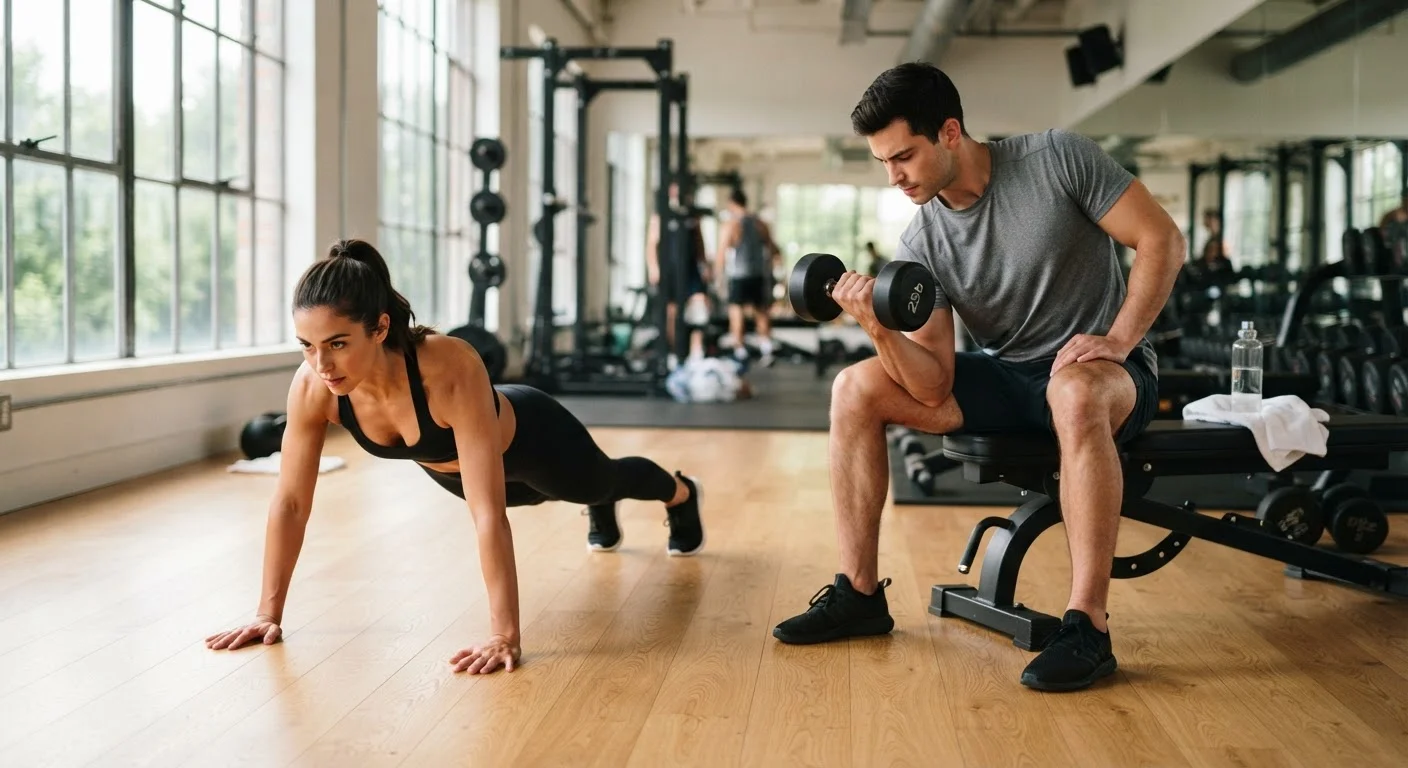
Photo: ConfiReads.com | Blogs For Inquisitive Minds editorial
Key Takeaways
- Both methods can build real strength and muscle when programmed with sufficient challenge and consistency.
- Bodyweight training excels in accessibility and convenience; free weights offer more precise, measurable progression.
- Your goals, living situation, budget, and experience level should drive the choice - not hype.
- Combining both approaches is a practical option many people overlook.
- Neither method is inherently superior; evidence supports both for general fitness and health.
What's Actually Different Between the Two?
At their core, both bodyweight training and free weights are forms of resistance exercise - they challenge your muscles to work against a force, which stimulates strength and muscle adaptations over time. The key difference is the source of that resistance.
With bodyweight training, your own body mass provides the load. Push-ups, pull-ups, squats, lunges, dips, and planks are classic examples. Difficulty is manipulated through leverage (e.g., elevating feet for push-ups), range of motion, tempo, and movement complexity.
With free weights - dumbbells, barbells, and kettlebells - an external load supplements or replaces your bodyweight as the resistance. This makes it straightforward to add or remove weight in small, measurable increments, a principle called progressive overload that is central to long-term strength development.
Understanding this distinction helps clarify why each tool has genuine strengths - and real limitations. For a broader look at how resistance training fits alongside cardio in a weekly plan, see our comparison of strength training and cardio.
| Criterion | Bodyweight Training | Free Weights |
|---|---|---|
| Equipment cost | None required | Moderate upfront investment |
| Progressive overload | Complex to scale precisely | Easy, measurable increments |
| Accessibility / convenience | Train anywhere, anytime | Requires gym or home equipment |
| Exercise variety | Good, but limited upper body pull | Broad, highly customizable |
| Beginner friendliness | High - low injury barrier | Moderate - technique matters |
| Muscle hypertrophy potential | Effective at lower levels | Strong long-term advantage |
| Functional / stabilizer engagement | High - natural movement patterns | Moderate - varies by exercise |
Where Bodyweight Training Has the Edge
The most obvious advantage of bodyweight training is accessibility. There's no gym membership to pay for, no equipment to buy, and no commute. This removes many of the friction points that cause people to abandon exercise programs early. Research consistently identifies convenience as one of the strongest predictors of exercise adherence.
Bodyweight movements also tend to build functional strength through compound, multi-joint patterns. A properly performed push-up engages the chest, triceps, shoulders, and core simultaneously - and because you're moving through space rather than guiding a weight along a fixed path, stabilizer muscles get meaningful work too.
For beginners especially, starting with bodyweight can reinforce sound movement mechanics before adding external load. And for those who travel often, bodyweight routines offer continuity without logistics. If you're looking to build a sustainable at-home program around these principles, our guide on building a home workout routine offers practical structure.
~73%
Adults citing convenience as a key exercise barrier
CDC physical activity surveys consistently find accessibility and time constraints among the top reasons Americans don't meet recommended activity levels.
Equal gains
Muscle growth: bodyweight vs. weighted resistance
A 2017 review in the Journal of Human Kinetics found comparable hypertrophy outcomes between bodyweight and loaded resistance training when effort and volume were matched.
2x/week
Minimum resistance training frequency recommended
The U.S. Department of Health and Human Services Physical Activity Guidelines recommend muscle-strengthening activity on at least two days per week for adults.
Where Free Weights Pull Ahead
The central advantage of free weights is scalable, measurable progression. Adding 5 pounds to a dumbbell curl is straightforward. Achieving an equivalent increase in difficulty with a push-up requires modifying leverage, adding a weighted vest, or learning a more advanced variation - all of which take more planning.
This precision matters most for intermediate and advanced trainees whose muscles have adapted to their current challenge level. Research on resistance training for muscle hypertrophy consistently points to progressive overload as a primary driver - and free weights make that easier to implement systematically.
Free weights also open up a wider exercise library. Movements like Romanian deadlifts, overhead presses, and rows are difficult or impossible to replicate with bodyweight alone, allowing more targeted work for specific muscle groups. For those whose strength goals evolve with age, how training needs shift across adulthood is worth reading alongside this comparison.
It's also worth flagging: some beliefs about which training style produces "real" results are based more on gym culture than evidence. Our article on common fitness myths addresses several of these directly.
A Note on Safety and Technique
The Case for Using Both - And How to Decide
For most everyday exercisers, the choice isn't binary. Many effective programs blend bodyweight and free weight movements in the same session - using bodyweight push-ups or dips alongside dumbbell rows, for example. This hybrid approach captures the functional benefits of bodyweight movements while maintaining the load-progression advantages of free weights.
When deciding where to start, consider these factors honestly:
- Goal: General fitness and movement quality? Either works. Specific hypertrophy or strength benchmarks? Free weights offer more precision.
- Budget and space: A basic set of adjustable dumbbells costs less than a few months of gym membership, but bodyweight costs nothing.
- Experience level: Beginners often benefit from bodyweight first; intermediate to advanced trainees typically need external load to keep progressing.
- Consistency: The method you'll actually do regularly beats the theoretically superior one you'll skip.
If structured workouts feel daunting, remember that even informal movement counts. Our piece on staying active without a formal workout is a useful complement for anyone building the habit from scratch.
This article is for general informational and educational purposes only and is not a substitute for professional medical or fitness advice. Consult a qualified healthcare provider or certified fitness professional before starting any new exercise program, particularly if you have an existing health condition or injury.
The content on this site is for informational purposes only and is not a substitute for professional advice. Always consult a qualified professional for guidance specific to your situation.