
Saving and Investing Across Every Life Stage

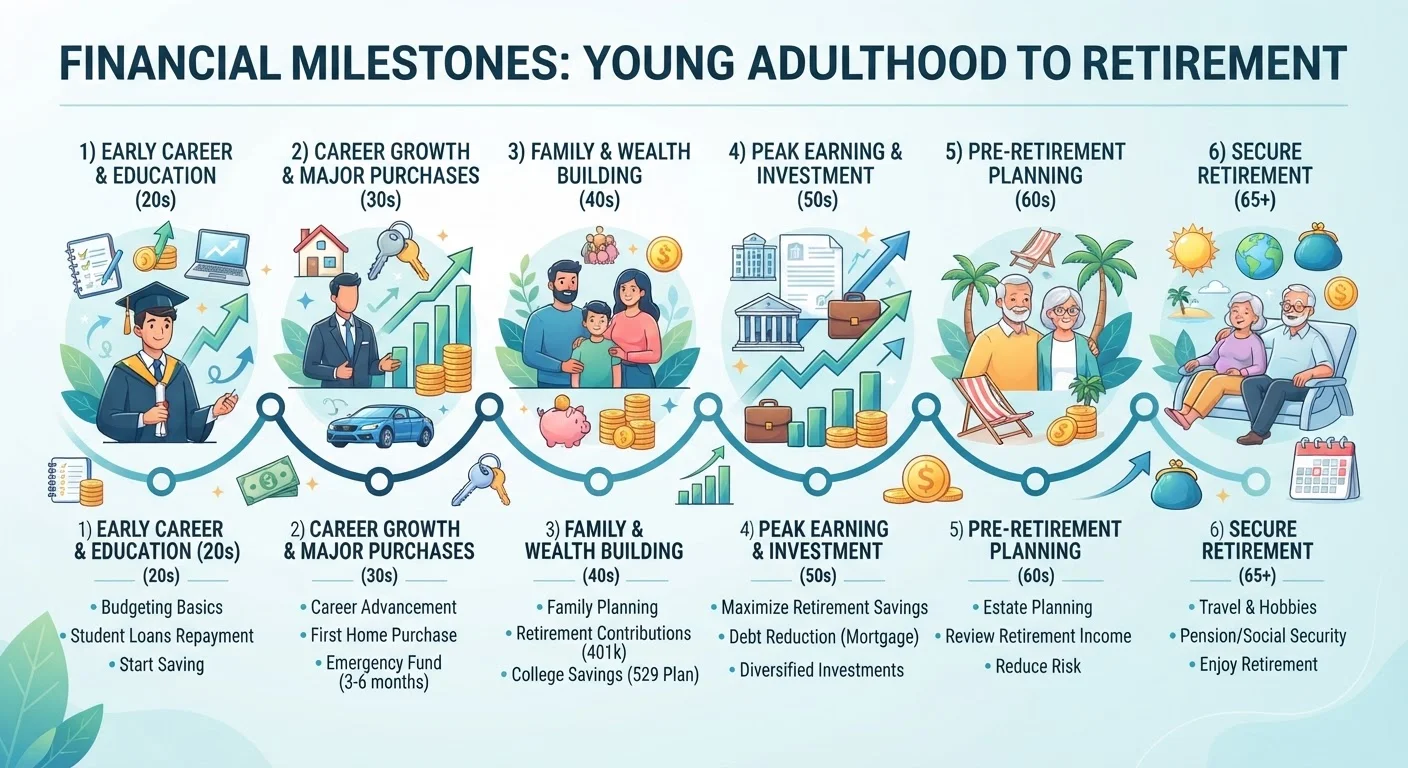
Photo: ConfiReads.com | Blogs For Inquisitive Minds editorial
Key Takeaways
- Starting early matters most - even modest contributions benefit from decades of compound growth.
- Asset allocation should generally shift toward lower risk as you approach retirement.
- Each life stage carries distinct financial priorities that shape how much to save and where to invest.
- Employer-sponsored plans and tax-advantaged accounts remain powerful tools at every age.
- A qualified financial adviser can help tailor strategies to your individual circumstances.
Why Life-Stage Investing Matters
Financial goals don't stay static. The priorities of a 25-year-old landing their first professional job are fundamentally different from those of a 55-year-old counting down to retirement. Yet many people operate with a one-size-fits-all approach - or no approach at all - because the landscape feels overwhelming.
Understanding how saving and investing strategies generally evolve over a lifetime gives you a framework to act with intention rather than guesswork. It helps you ask the right questions at each stage: How much risk is appropriate right now? Where should new savings go? What should I be protecting?
Before diving in, a note on framing: this article is general financial education, not personalised advice. For guidance tailored to your specific situation, consult a licensed financial adviser. And if some of the terminology feels unfamiliar, our plain-language glossary of saving and investing terms is a useful starting point.
~55%
Americans with access to a workplace retirement plan
According to the U.S. Bureau of Labor Statistics, roughly 55% of private-sector workers have access to an employer-sponsored retirement plan.
$87,000
Median retirement savings for Americans near retirement
Federal Reserve Survey of Consumer Finances data indicate that median retirement account balances for those approaching retirement are substantially lower than commonly recommended targets.
30 years
Typical retirement duration to plan for
Many financial planners suggest planning for a 25-30 year retirement horizon to reduce the risk of outliving savings, based on current U.S. life expectancy trends.
Your 20s: Build the Foundation
Time is the most powerful asset a young investor has. Even small, consistent contributions to a retirement account in your 20s can outpace much larger contributions made later, thanks to the compounding of returns over decades. This is not speculation - it's a mathematical reality that underpins virtually every long-term investment strategy.
Key priorities in your 20s
- Emergency fund first. Aim to build three to six months of living expenses in a liquid, accessible savings account before investing aggressively. Without this buffer, a job loss or unexpected expense can force you to liquidate investments at the wrong time.
- Capture employer matches. If your employer offers a 401(k) match, contribute at least enough to receive the full match. Leaving that benefit on the table is effectively declining part of your compensation.
- Consider a Roth IRA. If you're in a lower tax bracket now than you expect to be later, a Roth IRA - funded with after-tax dollars that grow and can be withdrawn tax-free in retirement - often makes sense in your 20s.
- Start budgeting intentionally. Knowing where your money goes is the prerequisite for directing it purposefully. See our stage-by-stage budgeting guide for practical context.
Automate your contributions from day one - even $50 a month - so saving happens before you have the chance to spend it. Behavioral inertia works in your favor when the default is saving.
In your 40s, run a retirement projection at least once a year using realistic return assumptions (not best-case scenarios). Catching a shortfall at 45 is far more manageable than discovering it at 60.
Your 30s: Accelerate and Protect
The 30s often bring higher income - but also higher expenses: mortgages, childcare, and growing lifestyle costs can squeeze savings rates if you're not deliberate. This is the decade to accelerate contributions while also building protective layers around your finances.
- Increase contribution rates. As income rises, aim to raise your retirement savings rate incrementally. Many planners suggest targeting 15% of gross income across all retirement accounts, including employer contributions.
- Review insurance coverage. Life and disability insurance become especially important if others depend on your income. A lapse in coverage at this stage can have lasting consequences.
- Revisit asset allocation. With retirement still 25-30 years away, a portfolio weighted toward equities (stocks) may still be appropriate, but your exact mix should reflect your risk tolerance and goals. Our companion article on what asset allocation means and why it changes explores this in depth.
Automate Savings Rate Increases
Your 40s: Peak Earning, Peak Stakes
For many Americans, the 40s represent peak earning years - but also a moment of reckoning. If saving was delayed in earlier decades, the gap becomes harder (though not impossible) to close. If you've been consistent, this is the time to optimise.
- Maximise tax-advantaged accounts. Annual contribution limits for 401(k)s and IRAs are set by the IRS and updated periodically. Hitting the maximum where feasible is one of the most efficient moves available to high-earners in this decade.
- Consider taxable brokerage accounts. Once tax-advantaged space is exhausted, a standard brokerage account offers flexibility that retirement accounts don't - no mandatory withdrawal schedules, no contribution limits.
- Address debt strategically. High-interest debt (credit cards, personal loans) should generally be paid down before investing in taxable accounts, since the effective return on eliminating 20% APR debt is hard to beat in any market.
- College savings if applicable. If you have children, 529 education savings plans offer tax advantages worth understanding - though contributions should not come at the expense of your own retirement savings.
“The four most dangerous words in investing are: 'This time it's different.' The principles of saving consistently, diversifying broadly, and managing costs matter at every age.”
— John Templeton, Pioneering global investor and mutual fund pioneer
Your 50s and 60s: The Pre-Retirement Shift
As retirement moves from abstract to concrete, two shifts become necessary: a gradual reduction in portfolio risk and a sharper focus on income planning. Sequence-of-returns risk - the danger that a market downturn early in retirement permanently damages a portfolio - becomes a genuine concern.
Catch-up contributions
The IRS allows workers aged 50 and older to contribute additional amounts above standard limits to 401(k)s and IRAs. These so-called catch-up contributions are a meaningful benefit for those who started late or had earnings gaps.
Gradually de-risking your portfolio
A portfolio that was 80% equities at 35 may be too volatile for someone five years from retirement. A common framework is to reduce equity exposure over time, increasing the share of bonds and other lower-volatility assets. There is no universal formula - your specific withdrawal timeline and risk tolerance matter. Learn more about allocation shifts over time.
Many investors in this stage also explore low-cost index funds and ETFs as core holdings. Passive investing through index funds and ETFs has become widely used precisely because it minimises fees and complexity during the accumulation phase.
Avoid Raiding Retirement Accounts Early
Retirement and Beyond: Spending What You've Built
Retirement introduces a new challenge: converting accumulated savings into sustainable income that may need to last 20-30 years. This is fundamentally different from the accumulation phase, and many retirees find they need active guidance to navigate it.
Key considerations in retirement
- Withdrawal strategy. The order in which you draw down accounts (taxable, tax-deferred, tax-free) can meaningfully affect your tax burden over time. This is an area where a qualified financial adviser or tax professional adds clear value.
- Required Minimum Distributions (RMDs). Traditional IRAs and 401(k)s require minimum withdrawals beginning at a certain age set by law. Failure to take RMDs results in significant IRS penalties.
- Social Security timing. Claiming Social Security early reduces your monthly benefit permanently; delaying it increases it. The optimal strategy depends on your health, other income sources, and household situation.
- Healthcare costs. Medical expenses tend to rise significantly in retirement. Accounting for these in your plan is essential - they are frequently underestimated.
The principles of sound budgeting don't disappear in retirement. The Budgeting Basics hub offers practical strategies for managing spending across every life phase.
This article is intended for general educational purposes and does not constitute personalised financial, investment, tax, or legal advice. Strategies appropriate for your situation depend on your individual circumstances. Please consult a qualified, licensed financial adviser or other professional before making decisions about your own finances.
The content on this site is for informational purposes only and is not a substitute for professional advice. Always consult a qualified professional for guidance specific to your situation.