
Personal Finance Through Every Life Stage: How Budgeting Needs Change

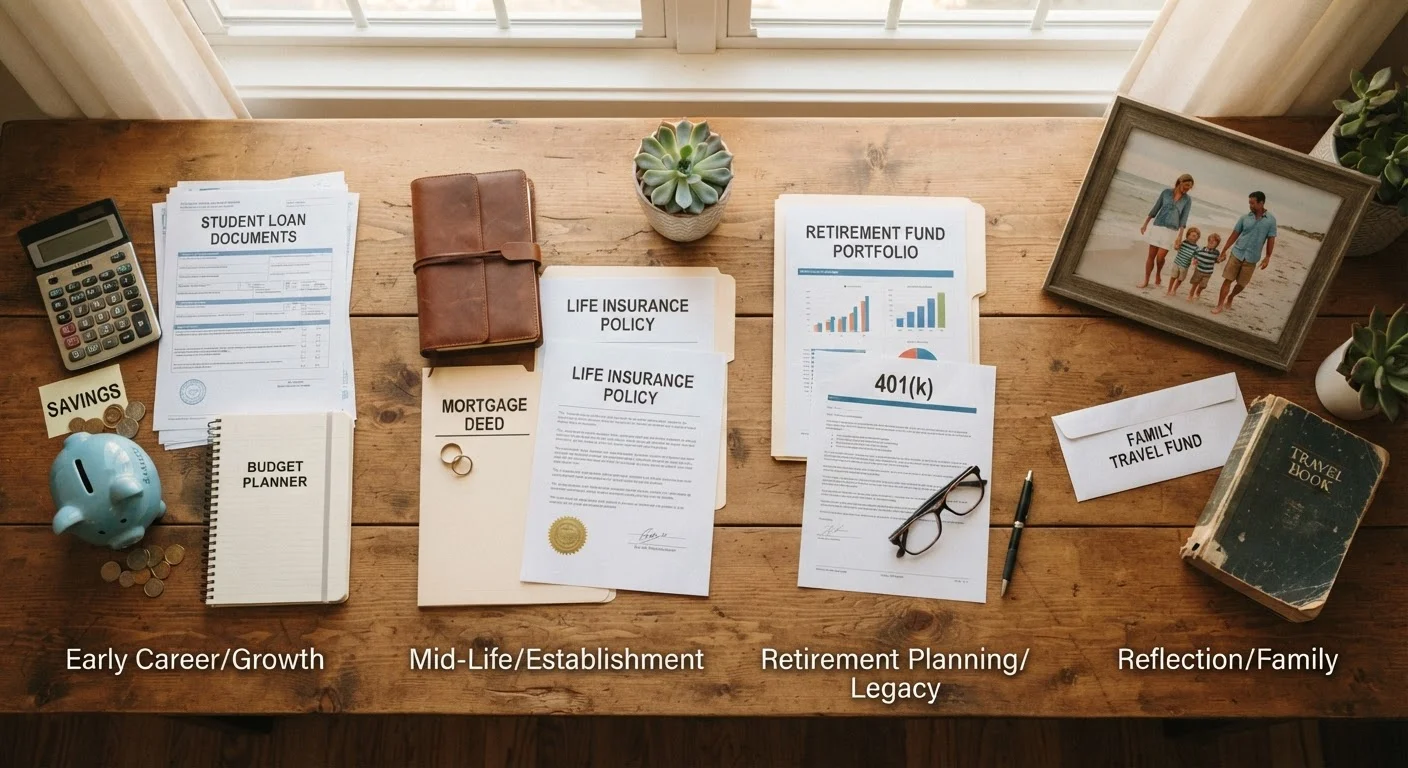
Photo: ConfiReads.com | Blogs For Inquisitive Minds editorial
Key Takeaways
- Budgeting priorities shift significantly across your 20s, 30s, 40s, 50s, and 60s.
- Each life stage introduces new financial obligations - and new opportunities to build wealth.
- Flexibility and regular reassessment are hallmarks of a budget that actually works long-term.
- Retirement planning should begin early but intensifies meaningfully in your 40s and 50s.
- Couples and families face layered financial decisions that require deliberate coordination.
Why Your Budget Can't Stay the Same Forever
A budget built for a 25-year-old sharing a city apartment looks almost nothing like one designed for a 55-year-old approaching retirement. Income grows, expenses multiply, priorities shift, and the financial risks you're managing evolve with every decade. Yet many Americans treat their budget as a fixed document rather than a living plan - and that mismatch costs them.
Understanding how budgeting needs change across life stages is one of the most empowering things you can do for your financial health. It lets you anticipate change rather than react to it. For a comprehensive foundation, see The Complete Roadmap to Long-Term Budget Mastery. The five stages below map out what your financial focus should look like - and why.
Your 20s: Build the Foundation
Early adulthood is the time to establish habits that compound over decades. Income is often modest and irregular, student loan repayments may be underway, and expenses like rent consume a disproportionate share of take-home pay. The priority here is building structure: create a workable spending plan, start an emergency fund targeting three to six months of expenses, and contribute at least enough to any employer-sponsored retirement account to capture the full employer match - that match is effectively part of your compensation.
Lifestyle inflation is the primary budget threat in your 20s. As income rises, resist the urge to immediately expand spending. Every dollar redirected to savings at 25 has significantly more time to grow than one saved at 45.
Every dollar saved at 25 has decades more compounding time than one saved at 45.
Your 30s: Budget for Complexity
The 30s tend to introduce compounding commitments: a mortgage or higher rent, childcare costs, growing career expenses, and possibly the financial merging of two lives. Couples navigating shared finances for the first time benefit from deliberate frameworks - see budgeting as a couple for practical approaches to aligning on goals.
Budgeting in your 30s means protecting the gains you've made while managing new obligations. Term life insurance and disability insurance become genuinely important, especially if dependents rely on your income. Retirement contributions should be growing alongside your income - aim to increase your savings rate by one percentage point with each raise.
Increase your savings rate by one percentage point with each salary raise.
Your 40s: Close the Gaps
The 40s are typically peak earning years for many Americans - and a critical window to close any gaps in retirement savings. If you fell behind in your 20s or 30s, this is the decade to course-correct aggressively. Review your asset allocation to ensure it still matches your timeline and risk tolerance; understanding how asset allocation shifts over time is essential reading as you approach the mid-point of your working years.
College funding for children may also enter the picture. Balance this against retirement savings carefully - there are loans available for education, but not for retirement. Your budget in the 40s should reflect a clear hierarchy: retirement first, then college savings, then other goals.
There are loans for college, but not for retirement - fund your future first.
Your 50s: Shift Toward Preservation
Once you reach 50, the IRS allows additional catch-up contributions to tax-advantaged retirement accounts - a meaningful opportunity for anyone who wants to accelerate savings in the final stretch of their career. Budget to take full advantage of these if your cash flow permits.
At the same time, begin stress-testing your retirement projections: What will your monthly expenses look like in retirement? Will Social Security, pensions, and savings cover them? This is also the time to reduce high-interest debt aggressively and reconsider whether your housing situation still makes financial sense. Downsizing can free up significant capital if your family home no longer matches your actual needs.
Catch-up contribution limits after 50 offer a real opportunity to accelerate retirement savings.
Your 60s: Plan the Transition
Budgeting in your 60s is less about accumulation and more about transition planning. Key decisions include when to claim Social Security benefits (delaying beyond 62 increases your monthly benefit, up to age 70), how to sequence withdrawals from different account types to manage tax exposure, and how to budget for healthcare costs - which often rise significantly in early retirement.
Building a retirement spending plan that distinguishes between fixed essential expenses and discretionary ones gives you flexibility to adjust if markets are volatile or unexpected costs arise. This isn't the finish line - it's the start of a new budgeting chapter that may span 20 to 30 years.
Retirement can last 20-30 years; treat it as a new budgeting chapter, not a finish line.
Adapting Your Budget for What Comes Next
No matter where you are in this progression, two principles hold: review your budget at least once a year, and review it again whenever your life changes materially - a new job, a relationship, a child, a health event. Just as physical and nutritional needs shift with age (a parallel worth noting - see how dietary needs shift across decades), financial needs demand the same kind of periodic recalibration.
Schedule an Annual Budget Review
For readers building wealth alongside their evolving budget, saving and investing across every life stage offers a complementary map of how investment strategy should shift in parallel with your spending plan. The goal at every stage is the same: a budget that reflects your actual life - not the one you had five years ago.
This article is for general informational and educational purposes only and does not constitute personalized financial, tax, or legal advice. Consult a licensed financial professional for guidance tailored to your specific circumstances.
The content on this site is for informational purposes only and is not a substitute for professional advice. Always consult a qualified professional for guidance specific to your situation.