
The Difference Between a Hard Inquiry and a Soft Inquiry

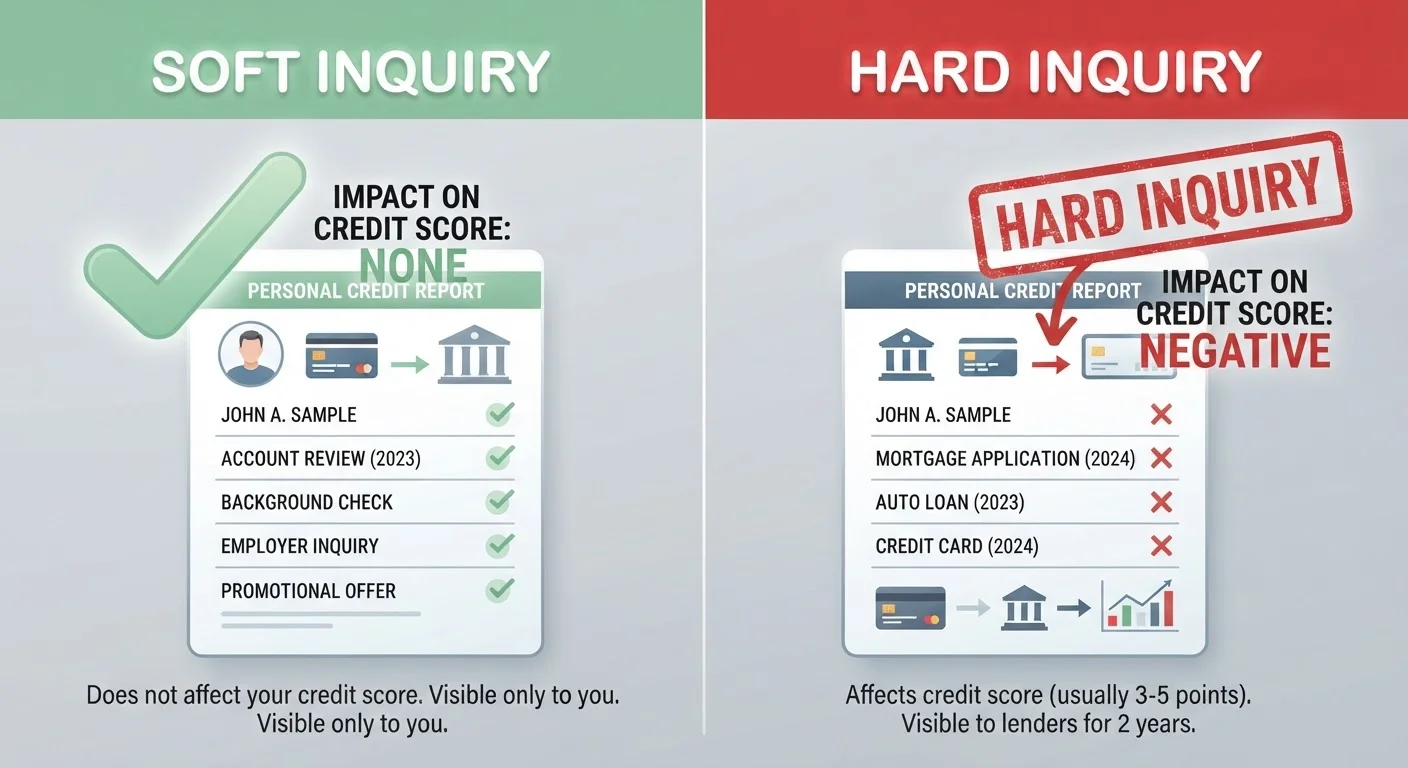
Photo: ConfiReads.com | Blogs For Inquisitive Minds editorial
Key Takeaways
- Soft inquiries never affect your credit score, regardless of how many occur.
- Hard inquiries can temporarily lower your score by a few points, usually for 12 months.
- Checking your own credit report always counts as a soft inquiry, not a hard one.
- Multiple hard inquiries for the same loan type within a short window are typically treated as one by scoring models.
- Hard inquiries remain on your credit report for two years but stop influencing your score after about one year.
What Triggers Each Type of Inquiry
Every time someone accesses your credit report, that access is logged. But the reason for the access determines whether it's recorded as a hard or soft inquiry - and that distinction matters considerably for your credit health.
Soft inquiries are generated by:
- Checking your own credit report or score
- Lenders performing pre-approval screenings
- Employers conducting background checks (with your consent)
- Existing creditors monitoring accounts they already hold
- Credit card companies making pre-qualified marketing offers
Hard inquiries are triggered when you formally apply for new credit, including:
- Credit card applications
- Mortgage or home equity loan applications
- Auto loan applications
- Personal loan or student loan applications
- Requests to increase your credit limit on an existing account (in some cases)
The key distinction is consent tied to a credit decision: hard inquiries arise when a lender is actively evaluating whether to extend you credit.
Employer Credit Checks Are Always Soft
How Hard Inquiries Affect Your Credit Score
Hard inquiries are one of five factors used in FICO score calculations, falling under the "new credit" category, which accounts for roughly 10% of your overall score. For most consumers, a single hard inquiry results in a dip of fewer than five points - a relatively minor effect, especially if the rest of your credit profile is solid.
<5 pts
Typical score drop from one hard inquiry
According to FICO, a single hard inquiry usually lowers a credit score by fewer than five points for most consumers.
10%
Weight of 'new credit' in FICO scoring
The FICO scoring model allocates approximately 10% of score weight to the new credit category, which includes recent hard inquiries.
2 years
How long hard inquiries remain on your report
Hard inquiries stay visible on credit reports for 24 months, though their influence on scoring typically fades after 12 months.
The damage compounds when multiple hard inquiries accumulate over a short period outside of rate-shopping scenarios. A string of applications for different credit products - a credit card, a personal loan, and a store account within weeks - signals risk to scoring models and can produce a more meaningful score reduction.
Importantly, hard inquiries lose most of their scoring impact after about 12 months, even though they remain visible on your report for two full years. If you're actively building credit responsibly, spacing out applications is a practical habit to protect your score.
Rate Shopping: When Multiple Hard Inquiries Don't Stack Up
One of the most consumer-friendly features of modern credit scoring is the rate-shopping window. When you're applying for a mortgage, auto loan, or student loan, shopping multiple lenders to find the best rate is financially smart - and scoring models accommodate it.
FICO generally groups hard inquiries of the same loan type made within a 45-day window into a single inquiry for scoring purposes. The older FICO models use a narrower 14-day window. VantageScore applies a similar approach. The practical result: you can compare offers from several lenders without multiplying the damage to your score.
This protection applies specifically to installment loans like mortgages and auto loans. It does not extend to credit card applications - each card application is counted separately. Understanding this nuance is useful context alongside other factors like credit utilization, which carries far more weight in score calculations than inquiries do.
Time Your Applications Strategically
Keeping Tabs on Your Own Credit - Without the Penalty
A persistent myth holds that checking your own credit report damages your score. It does not. As noted, self-checks are always soft inquiries. In fact, reviewing your own report regularly is one of the most effective habits for credit management - it lets you catch errors, spot unauthorized accounts, and track your progress.
You're entitled to free weekly access to your reports from all three major bureaus (Equifax, Experian, and TransUnion) through AnnualCreditReport.com, the federally mandated source. If you discover a hard inquiry you don't recognize, that's a red flag worth investigating. It could indicate a data error or, in more serious cases, fraudulent activity. Our guide on what to do when your credit report has an error walks through the dispute process.
For a broader view of how individual factors - including inquiries - accumulate into your overall credit profile over time, see how credit scores build year by year. And for a list of things people assume hurt their score but actually don't, this overview covers common misconceptions clearly.
This article is for informational purposes only and does not constitute personalized financial or credit advice. Consult a licensed financial professional for guidance specific to your situation.
Frequently Asked Questions
The content on this site is for informational purposes only and is not a substitute for professional advice. Always consult a qualified professional for guidance specific to your situation.