
Reading a Pet Food Label: What the Ingredients List Actually Tells You

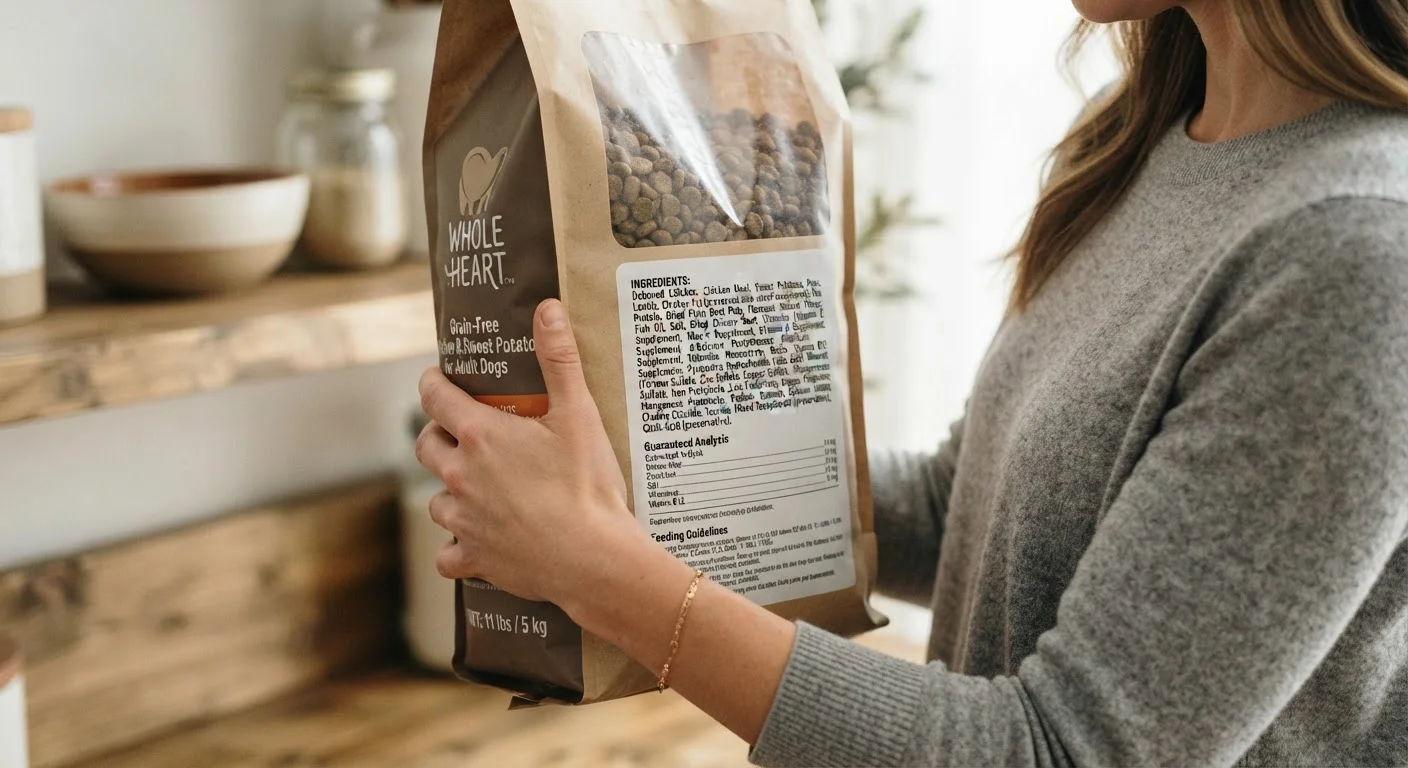
Photo: ConfiReads.com | Blogs For Inquisitive Minds editorial
How the Ingredients List Is Structured
Pet food ingredients are listed in descending order by pre-cooking weight - the heaviest ingredient comes first. This sounds straightforward, but moisture complicates things. Fresh chicken, for example, is roughly 70% water by weight. Once cooked, that same chicken shrinks considerably, meaning it may contribute less actual protein than a meat meal listed further down the list.
This is why "chicken meal" or "salmon meal" ranked third or fourth can still be a significant protein source. Meal ingredients have already had most of their moisture removed, so their weight on the label more closely reflects their dry nutrient contribution. Understanding this distinction helps you look past simple first-ingredient marketing.
For a broader look at how ingredient lists are governed across food categories, see our guide to reading ingredient lists.
| Ingredient List Order | Listed by pre-cooking weight, heaviest first (AAFCO model regulations) |
| AAFCO Substantiation Methods | Nutrient profile formulation or feeding trial (AAFCO Official Publication) |
| Guaranteed Analysis: Key Nutrients | Crude protein, crude fat, crude fiber, moisture (Required minimums/maximums under U.S. feed regulations) |
| Life Stages Recognized by AAFCO | Growth, adult maintenance, reproduction, all life stages (AAFCO model pet food regulations) |
| Moisture Content: Dry vs. Wet Food | ~10% (dry kibble) vs. ~75-82% (canned) (Typical industry values; varies by product) |
Ingredient Splitting and Why It Matters
One of the most important tactics to recognize is ingredient splitting. A manufacturer might list corn-derived ingredients as "ground corn," "corn gluten meal," and "corn flour" separately. Individually, each appears lower on the list - but combined, they may outweigh the chicken listed first.
This isn't illegal, but it does mean that a protein appearing at the top of the list isn't automatically the dominant ingredient by weight. When you see multiple forms of the same base ingredient scattered through the list, add them up mentally before drawing conclusions about what the food is primarily made of.
AAFCO
The Association of American Feed Control Officials, a non-governmental body that establishes model nutrient profiles and ingredient definitions used by most U.S. states to regulate pet food. AAFCO itself does not test or approve products, but its standards guide what manufacturers must demonstrate.
Ingredient Splitting
A labeling practice in which a single ingredient (such as corn) is broken into multiple sub-forms (corn flour, corn gluten, ground corn) so that each appears separately and lower on the list, making a higher-ranked protein appear more prominent than it may actually be.
Guaranteed Analysis
The panel on a pet food label that lists minimum or maximum percentages of key nutrients - typically crude protein, crude fat, crude fiber, and moisture. These are regulatory minimums or maximums, not precise values.
Complete and Balanced
A claim that a food meets established nutrient profiles for a named life stage (e.g., adult maintenance, growth, all life stages), either by formulation against AAFCO nutrient profiles or by passing a feeding trial.
As-Fed vs. Dry Matter Basis
As-fed values reflect nutrient percentages in the food as purchased, including moisture. Dry matter basis removes moisture from the calculation, making nutritional comparisons between wet and dry foods more accurate.
Meat Meal
A rendered, concentrated protein ingredient made by cooking animal tissue and removing most of the water and fat. Because moisture is removed, meal ingredients can actually deliver more protein by weight than their fresh counterparts listed ahead of them.
The AAFCO Statement: What 'Complete and Balanced' Actually Means
Somewhere on the label - often near the bottom - you'll find a nutritional adequacy statement. This is where the AAFCO claim lives. A food labeled "complete and balanced" has met nutrient requirements for a stated life stage through one of two methods: formulation against AAFCO nutrient profiles, or a controlled feeding trial.
Feeding trials are generally considered stronger evidence that animals can actually thrive on the food, not just that the formula contains the right numbers on paper. Look for language like "Animal feeding tests using AAFCO procedures substantiate that provides complete and balanced nutrition."
Also check the life stage specified. A food suitable for "adult maintenance" is not necessarily appropriate for a growing puppy or a pregnant cat. "All life stages" covers the broadest range but must meet the highest nutrient thresholds. If the label says "for supplemental feeding only" or carries no adequacy statement at all, that food is not intended as a sole diet.
Many popular claims - like grain-free being inherently healthier - are not backed by the same regulatory framework. Our article on pet nutrition myths unpacks those misconceptions in detail.
Labels Don't Tell the Whole Story
The Guaranteed Analysis Panel and Dry Matter Comparisons
The guaranteed analysis panel lists crude protein, crude fat, crude fiber, and moisture as minimums or maximums - not precise values. "Crude" refers to the measurement method (nitrogen-based for protein, ether extraction for fat), not the quality of the ingredient.
Where this panel becomes most useful is when comparing wet and dry foods. A canned food might show 10% crude protein while a kibble shows 30% - but canned food is 75-82% moisture. To compare fairly, convert both to a dry matter basis by dividing the nutrient percentage by the percentage of dry matter (100 minus moisture %). On a dry matter basis, that canned food's protein often looks much more competitive. See our dry food vs. wet food comparison for more on this calculation.
#1 Rule
Ingredients listed by pre-cooking weight
Water content in fresh meats makes them heavier pre-cooking, which can inflate their apparent ranking on the ingredient list.
2 Methods
Ways a food can earn 'complete and balanced'
AAFCO recognizes nutrient-profile formulation and live feeding trials as the two valid substantiation methods for this claim.
This article is for general informational purposes only and is not veterinary or nutritional advice. Always consult a licensed veterinarian before making significant changes to your pet's diet, especially for animals with health conditions, life-stage-specific needs, or food sensitivities.
The content on this site is for informational purposes only and is not a substitute for professional advice. Always consult a qualified professional for guidance specific to your situation.