
Whole Grains vs. Refined Grains: Why the Processing Step Matters

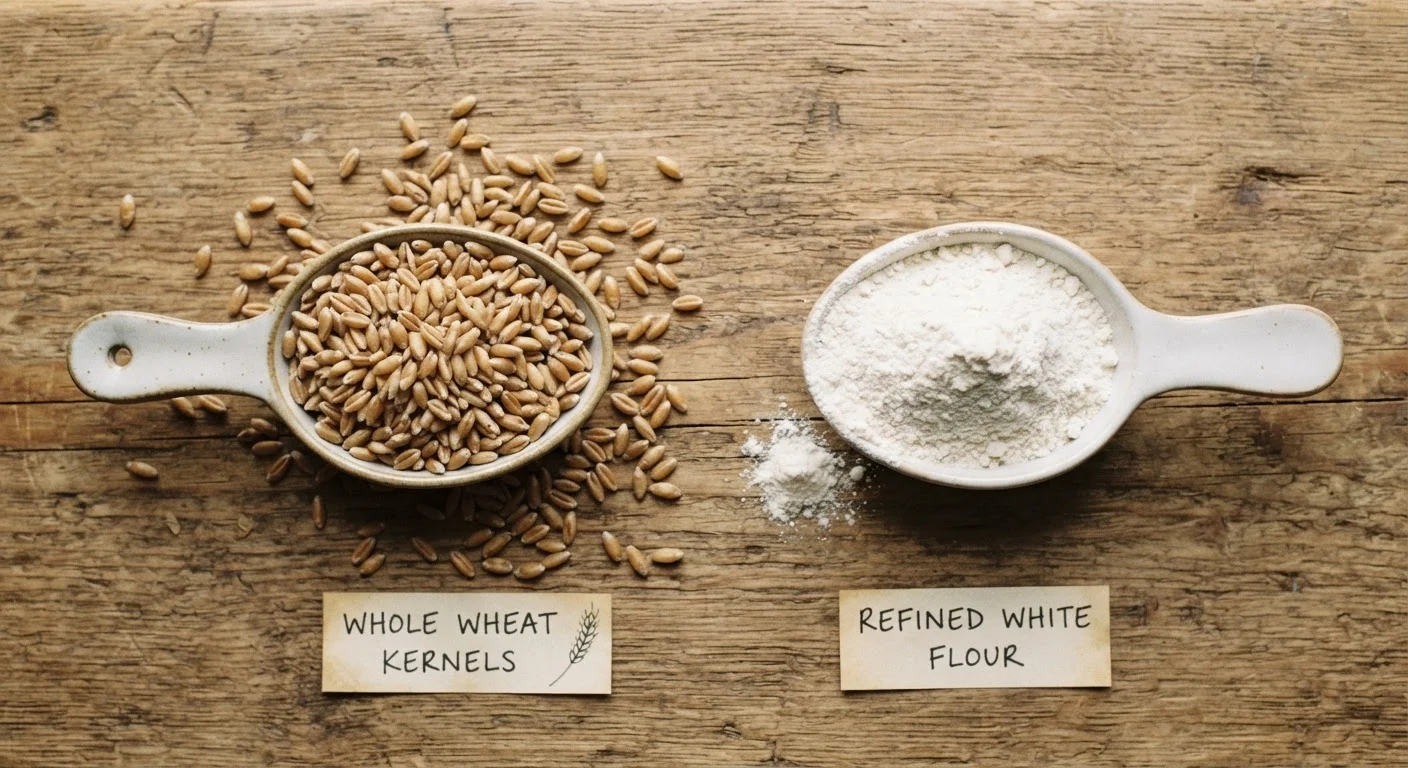
Photo: ConfiReads.com | Blogs For Inquisitive Minds editorial
Key Takeaways
- Refining removes the bran and germ, stripping fiber, B vitamins, iron, and other nutrients.
- Enrichment restores some B vitamins and iron but does not replace fiber or phytonutrients.
- Most dietary guidelines recommend making at least half of daily grains whole grains.
- The fiber gap between whole and refined grains has measurable effects on blood sugar and gut health.
- Label reading is essential - 'wheat bread' and 'multigrain' do not automatically mean whole grain.
What Happens Inside a Grain During Processing
A grain kernel has three layers: the outer bran, the nutrient-rich germ, and the starchy inner endosperm. A whole grain retains all three in their natural proportions. When a grain is refined - typically by milling - the bran and germ are removed, leaving almost entirely the endosperm.
That single processing step has significant nutritional consequences. The bran holds most of the grain's dietary fiber, along with B vitamins like thiamine, niacin, and folate. The germ contributes healthy fats, vitamin E, and additional B vitamins. What remains after refining is largely starch with a fraction of the original nutrient profile. For a clear breakdown of the nutrients involved, the nutrients glossary is a useful starting point.
Manufacturers may then enrich refined grains by adding back select B vitamins and iron - but enrichment is partial. Fiber is not restored, and most phytonutrients and trace minerals lost during milling are not replaced.
| Criterion | Whole Grains | Refined Grains |
|---|---|---|
| Kernel layers retained | All three (bran, germ, endosperm) | Endosperm only |
| Dietary fiber | High | Very low |
| B vitamins | Naturally present | Partially restored via enrichment |
| Glycemic response | Lower (slower digestion) | Higher (faster digestion) |
| Phytonutrients | Present (lignans, phenolic acids) | Largely removed |
| Shelf life | Shorter (germ oils can go rancid) | Longer |
| Texture and palatability | Denser, heartier | Lighter, softer |
The Nutritional Gap in Practice
The difference between a slice of 100% whole wheat bread and a slice of standard white bread is not subtle on paper. Whole wheat bread typically delivers two to three times the fiber of its refined counterpart. That fiber matters because it slows the digestion of starches, producing a more gradual rise in blood glucose - a factor relevant to energy levels and, over time, metabolic health.
~95%
Americans falling short of whole grain recommendations
Dietary Guidelines for Americans data consistently show the vast majority of U.S. adults consume far fewer whole grains than recommended.
2-3×
More fiber in whole vs. refined grain servings
A typical serving of 100% whole wheat bread contains roughly two to three times the fiber of an equivalent serving of white bread.
21%
Lower cardiovascular disease risk in high whole grain consumers
A 2016 meta-analysis published in the British Medical Journal found higher whole grain intake was associated with meaningfully lower rates of cardiovascular disease.
Fiber also feeds the gut microbiome. Research on gut health consistently points to dietary fiber as a primary driver of microbial diversity, with whole grains cited as a meaningful contributor in large dietary studies. Refined grains, stripped of bran, do not offer the same benefit.
It's worth noting that not all refined grain products are nutritionally identical. Enriched white flour products recover some of the B vitamin losses, which matters in populations where micronutrient deficiencies are a concern. Folic acid enrichment of grain products, for instance, has been associated with significant reductions in neural tube defects since it became mandatory in the U.S. in 1998.
Reading Labels Carefully - It's More Complicated Than It Looks
Marketing language on grain products is notoriously imprecise. Terms like multigrain, made with whole grain, wheat bread, and stone-ground do not legally require that the product is predominantly whole grain. The only reliable indicator on a label is seeing a whole grain listed as the first ingredient - such as "whole wheat flour" or "whole oat flour."
The ingredient list guide explains how ingredient ordering works and why the first item carries the most weight. Applying that knowledge to grain products makes a real difference at the grocery store.
One common diet pitfall is assuming darker bread equals whole grain - caramel color additives can make refined products look heartier than they are. Checking the ingredient list directly remains the most reliable method.
The 'Whole Grain Stamp' Is Helpful But Not Foolproof
This article is for general informational and educational purposes only and is not a substitute for personalized medical or dietary advice. Consult a qualified healthcare professional or registered dietitian for guidance specific to your health needs.
The content on this site is for informational purposes only and is not a substitute for professional advice. Always consult a qualified professional for guidance specific to your situation.