
Roundabouts, Four-Way Stops, and Uncontrolled Intersections: A Traffic Law Reference

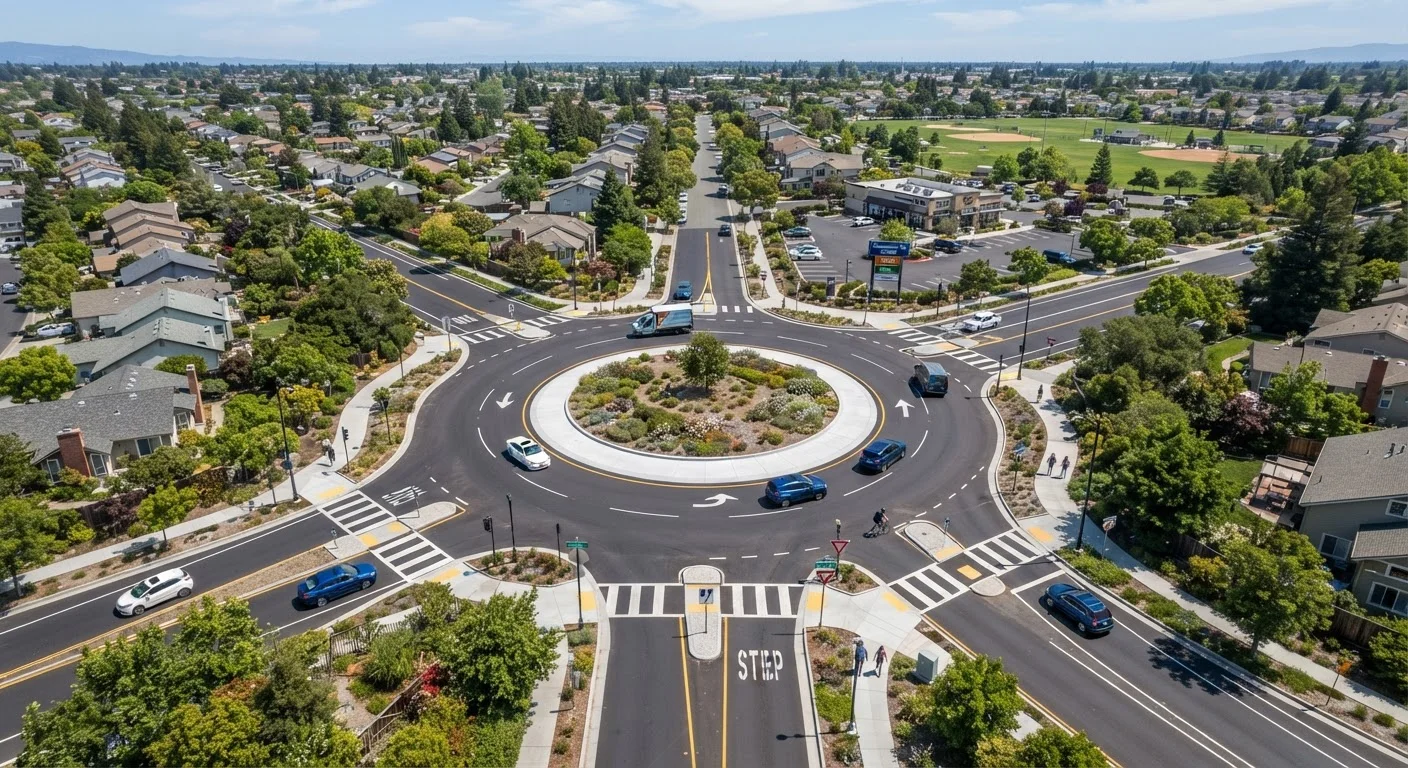
Photo: ConfiReads.com | Blogs For Inquisitive Minds editorial
How These Three Intersection Types Differ
Intersections are where most crashes happen. The Federal Highway Administration consistently identifies them as high-risk zones, and driver error - specifically misreading right-of-way - is the leading contributing factor. Three intersection formats generate the most confusion: roundabouts, four-way stops, and uncontrolled intersections. Each operates under a distinct legal framework, and understanding that framework is the first step toward safer navigation.
| Roundabout right-of-way holder | Vehicles already in the circle (Consistent across all U.S. state vehicle codes) |
| Four-way stop primary rule | First to stop, first to go (Standard U.S. traffic law) |
| Simultaneous arrival tiebreaker | Yield to the vehicle on your right (Applies at both four-way stops and uncontrolled intersections) |
| Roundabout traffic direction | Counterclockwise (in the U.S.) |
| Roundabout injury crash reduction | ~75% vs. traditional intersections (Federal Highway Administration research) |
| Uncontrolled intersection rule | Yield to traffic already present or approaching from the right (Standard across U.S. state vehicle codes) |
This reference is part of a broader look at intersection safety. For a comprehensive overview of U.S. traffic laws and defensive habits, see the complete road safety guide for American drivers. If you want to go deeper on right-of-way specifically, the right-of-way rules most drivers get wrong is a useful companion piece.
Roundabouts: Yield, Enter, and Keep Moving
A roundabout is a circular intersection where all traffic moves counterclockwise around a central island. The controlling rule is straightforward: vehicles already in the circle have the right of way. Entering drivers must yield at the yield line - not stop unless traffic requires it.
Key Legal Points
- Yield, don't stop: Stopping inside the roundabout (when the lane is clear) can cause rear-end collisions and is generally unlawful.
- Lane discipline: Multi-lane roundabouts require drivers to choose the correct lane before entry. Right-lane exits use the right lane; passing through or exiting left typically uses the left lane. Specific markings vary by jurisdiction.
- Pedestrians and cyclists: Crosswalks are placed outside the circulatory roadway. Drivers exiting the roundabout must yield to pedestrians in those crosswalks.
- Emergency vehicles: Pull out of the roundabout before stopping - never stop inside the circle to accommodate an emergency vehicle.
Roundabouts reduce injury crashes by roughly 75% compared with traditional signalized intersections, according to FHWA research, largely because conflicting movements and high-speed T-bone collisions are eliminated by design.
Roundabout
A circular intersection where traffic moves counterclockwise around a central island. Entering vehicles must yield to those already circulating.
Four-way stop
An intersection where all approaches are controlled by stop signs. Priority is determined by arrival order, with a yield-to-the-right tiebreaker.
Uncontrolled intersection
An intersection with no traffic signs, signals, or pavement markings. Right-of-way is governed by state law requiring a yield to vehicles on the right or already in the intersection.
Right of way
The legal right of a vehicle or pedestrian to proceed before others in a given traffic situation. It is granted by law - not taken by assumption.
Yield
To slow down or stop as needed to allow another vehicle or pedestrian with the legal right of way to proceed safely.
Circulatory roadway
The one-way travel lane inside a roundabout that vehicles use to navigate around the central island.
Four-Way Stops: The Arrival-Order System
A four-way stop (also called an all-way stop) places a stop sign on every approach. The rules are sequential and legally consistent across all 50 states, though minor wording varies by state vehicle code.
Priority Rules in Order
- First to stop, first to go. The driver who stopped first proceeds first. This is the foundational rule.
- Simultaneous arrival - yield to the right. When two vehicles arrive at the same time, the driver on the left yields to the driver on the right.
- Simultaneous arrival, directly opposite - straight traffic first. When two vehicles face each other and one intends to turn left, the turning driver yields to the driver going straight or turning right.
- Ties involving three or four vehicles are resolved by a combination of the above principles; when ambiguous, brief eye contact, hand signals, or waiting for another vehicle to commit is the practical resolution.
A full stop means the vehicle must come to a complete halt - not a rolling pause - before the stop line or, where no line exists, before the crosswalk or edge of the intersecting roadway.
Rolling Stops Are Not Legal Stops
Uncontrolled Intersections: The Most Misunderstood Category
An uncontrolled intersection has no signs, signals, or markings governing right of way. These appear most often on residential side streets and rural roads. Many drivers assume they can treat these as free-for-all zones - they cannot.
The Legal Standard
All U.S. states require that drivers approaching an uncontrolled intersection yield to vehicles that have already entered the intersection or are approaching from the right at approximately the same time. In practice:
- If another vehicle is already in the intersection, wait.
- If you arrive simultaneously, yield to the vehicle on your right.
- If you are on a road that ends into another (a T-intersection), you yield to through-traffic even without a sign.
Speed matters enormously here. Approach uncontrolled intersections with enough reduced speed to stop if necessary. Conditions like poor sight lines, overgrown vegetation, or parked vehicles make this especially critical. For more on adjusting your behavior to changing road conditions, see how road surfaces affect your driving.
Crashes at uncontrolled intersections often involve drivers who do not recognize the intersection type until they are already in it. Slowing well before the intersection - not just at it - is the safest defensive habit. For related techniques around lane positioning and speed management, {{link:/cars-driving/road-safety/highway-merging-and-lane-changes-done-right|safe lane changes and merging}|safe lane changes and merging}} covers complementary principles.
This article provides general traffic law information for educational purposes only. Traffic laws vary by state and locality. Always consult your state's official driver handbook or a licensed legal professional for guidance specific to your jurisdiction.
The content on this site is for informational purposes only and is not a substitute for professional advice. Always consult a qualified professional for guidance specific to your situation.