
What Happens Inside Your Engine When You Skip an Oil Change

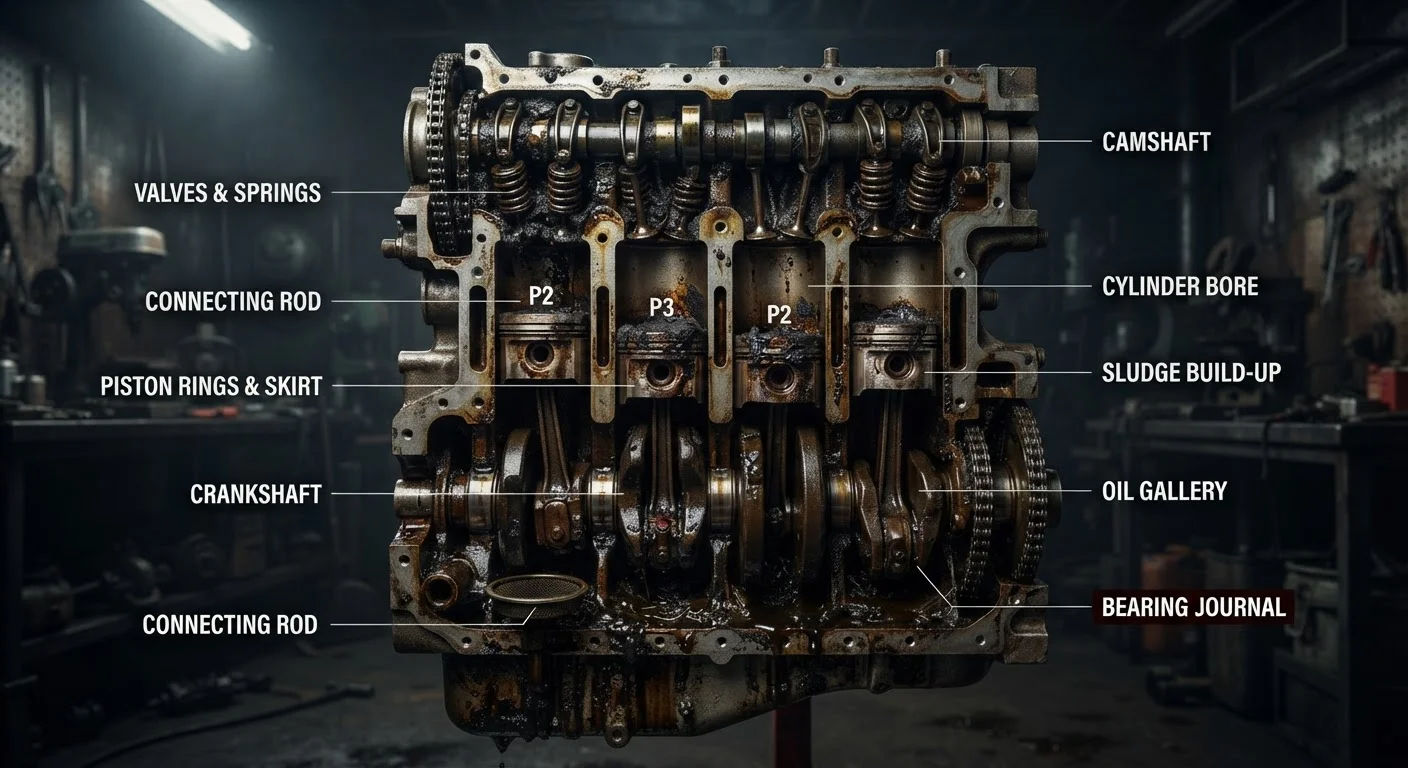
Photo: ConfiReads.com | Blogs For Inquisitive Minds editorial
Key Takeaways
- Old oil loses its ability to lubricate, causing metal components to grind against each other.
- Degraded oil turns into sludge that can clog oil passages and starve engine parts of lubrication.
- Skipping oil changes can void your powertrain warranty and lead to engine replacement costs.
- Most modern vehicles with synthetic oil can go 7,500-10,000 miles between changes, but that interval still matters.
- Catching a missed oil change early rarely causes lasting damage; repeated neglect is what destroys engines.
The Chain Reaction That Starts the Moment Oil Degrades
Engine oil isn't just a lubricant - it's a multi-tasking fluid that reduces friction, transfers heat away from metal surfaces, suspends combustion byproducts, and keeps internal components clean. Fresh oil does all of this efficiently. Oil that has been in an engine well past its service interval does almost none of it.
As oil ages, its base stock breaks down at the molecular level and its additive package - the detergents, dispersants, and anti-wear agents blended in at the refinery - gets depleted. What remains is a thicker, darker fluid increasingly contaminated with metal particles, carbon soot, and moisture. This is the early stage of a problem that compounds quickly.
The first sign is increased friction. Metal surfaces in the valvetrain, crankshaft bearings, and piston rings that rely on a thin film of oil for separation begin to make more direct contact. This generates heat, and heat accelerates oil breakdown further - a self-reinforcing cycle that worsens with every mile.
Understanding what a proper oil change interval actually looks like for your specific vehicle is worth taking seriously. See our guide to oil change intervals for a full breakdown of how manufacturers set those schedules and why they vary.
$4,000-$8,000+
Typical cost of engine replacement due to oil neglect
Engine rebuilds or replacements resulting from lubrication failure consistently rank among the most expensive non-collision repairs a driver can face, according to automotive repair industry data.
~$80-$150
Average cost of a full synthetic oil change
Routine synthetic oil changes represent a fraction of the repair costs associated with sludge damage or bearing failure caused by deferred maintenance.
Common Mistakes Drivers Make - and Why They're So Costly
Most drivers who skip or delay oil changes aren't being reckless - they're making predictable, understandable errors. The problem is that engines don't give obvious warning signs until significant damage has already occurred.
Assuming the oil light is the only warning sign that matters.
Applying the old 3,000-mile rule to modern vehicles using synthetic oil.
Topping off degraded oil instead of changing it.
Skipping oil changes during periods of low mileage or vehicle storage.
The financial consequences of these mistakes rarely stay small. As outlined in our article on the real cost of deferred car maintenance, routine neglect has a way of compounding into repairs that dwarf the original savings.
Skipping Oil Changes Can Void Your Warranty
What Sludge Actually Does to an Engine
Sludge - the gel-like residue that forms when severely degraded oil oxidizes and thickens - is the most destructive long-term consequence of skipped oil changes. It accumulates in oil passages, the oil pan, and around the valve cover area, physically blocking the flow of whatever fresh oil remains.
When oil passages become restricted, critical components like camshaft bearings and hydraulic lifters receive inadequate lubrication. Lifters may start ticking or collapse entirely, leading to misfires and valve timing issues. In severe cases, a sludged engine can experience oil starvation at the point where the oil pump pickup tube is blocked - a condition that can seize an engine in minutes.
Sludge removal, when it's even possible, typically requires engine disassembly and professional cleaning. In many cases, the damage to bearing surfaces is already done, meaning a full engine replacement is the only practical solution. Repair bills in this range routinely run into the thousands - far exceeding years' worth of timely oil changes.
It's also worth noting that some widely repeated beliefs about oil and engine care don't hold up. Our coverage of car ownership myths that cost drivers real money addresses several misconceptions that lead drivers to delay necessary maintenance.
This article provides general educational information about vehicle maintenance. Always consult your owner's manual and a qualified mechanic for advice specific to your vehicle.
The content on this site is for informational purposes only and is not a substitute for professional advice. Always consult a qualified professional for guidance specific to your situation.